Integrating AI and Analytics in the Data-Driven Enterprise
description.
Although analytics in many organizations is well established, it is still the case that perhaps no more than 25% of employees make use of reports and dashboards from Business Intelligence (BI) tools with even fewer using machine learning (ML) models or Artificial intelligence (AI). There is still a long way to go if companies are to realise the promise of using ML and AI to automatically prevent problems, seize opportunities, and continually optimize business processes in everyday business operations.
However, the arrival of Generative AI has had a massive impact. Businesses have realised the huge productivity benefits, cost reduction and efficiency opportunities that AI brings, plus the ability to make timelier and better decisions. Business priorities have therefore changed to the point where data and analytics are now strategic and demanded in every part of the business.
The vision is to maximize use of conversational analytics, classic ML and AI agents to provide better insights, increase the level of AI automation and deploy AI agents to assist and automate tasks, and automate more operational decisions. Executives want everyone in the company to leverage data and analytics to contribute towards improving overall business performance. They want to create an ‘always on’ data and AI-driven intelligent business where conversational analytics, ML models, Generative AI and AI agents are deployed right across the business so that every person, and every application, in the enterprise is able to leverage the right insights at the right time in every activity to help them contribute to the overall performance of the business.
Therefore, it should be possible to embed BI, conversational analytics, ML models and AI agents into operational business processes to guide and drive decisions and actions in everyday business operations. It should also be possible to automate more using self-learning AI agents that can reason, plan, orchestrate, automate and assist. This would move organisations towards creating intelligent applications, and utilising AI automation for right-time business process optimisation and decision management. This includes embedding analytics and AI into all customer-facing applications and websites to enable a personalised customer experience as well as partners and suppliers being guided by explainable BI, alerts, and recommendations, and Generative AI-agents. The objective is to move towards automated, self-learning, AI-driven business operations.
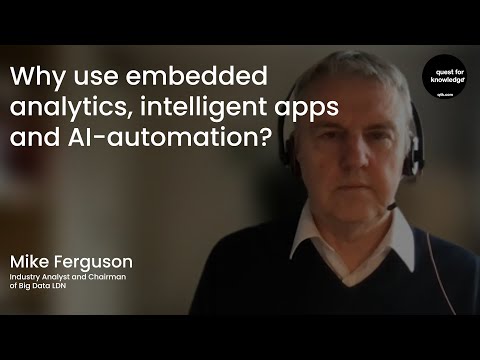
This 2-day course shows how you can embed BI, ML, AI agents and AI automation into applications and processes to make your company data and AI-driven. The purpose is to achieve ‘always on’ business optimization, dynamic planning by automating, guiding and empowering employees, business partners, suppliers and customers to make better decisions to improve business performance. It provides a roadmap and methodology to creating the right-time intelligent enterprise by taking an in-depth look at the technologies and methodologies needed to make it happen.
Why attend
You will learn:
- Justify, architect, and integrate AI agents, classic ML models and BI into operational business processes as part of a coordinated program to improve business performance
- Use automatic real-time event processing to monitor operational events as they happen to detect problems, identify opportunities, and deploy rule-driven and AI agent driven automated decisions to guide everyday business operations
- How to use AI-Agents as a digital workforce to automate tasks
- Use real-time data integration, on-demand decision services, prescriptive ML models as a service, BI web services, queries, real-time decision engines, enterprise alerting, and business process automation to put analytics to work in driving everyday business operations
- How to use AI in data management, self-service analytics, and data science
Who should attend
This course is intended for business and IT professionals responsible for information delivery, business integration, and leveraging analytics, ML and AI in operational environments. It assumes that you have already built analytical systems and are now looking to leverage insights produced in everyday operations.
outline.
An Introduction to Data And AI-Driven Business Optimization
This module looks at how embedded analytics, classic machine learning (ML) and Artificial intelligence (AI) automation can help companies improve efficiency and effectiveness of decision making in operational business processes.
- An introduction to data and AI-driven business optimization
- What do we mean by embedded analytics?
- What is AI-automation and what can AI agents do?
- Business benefits - Why use embedded analytics, event-driven prescriptive ML models, and AI automation?
- How can AI automation help optimize business and improve effectiveness?
- Examples and case studies of using embedded analytics and AI-automation in practice
- What's needed to get started?
Technologies and Tools for the Data and AI-Driven Enterprise
This module looks at the technology components to consider when implementing embedded analytics and AI automation.
- Data Fabric, Data Catalog, and Data Marketplace software
- AI-powered BI / Analytics platforms supporting embedded analytics
- What can you do with embedded analytics?
- AI agents leverage BI and specialized tools through MCP
- Enabling LLMs to access a BI tool MCP server
- Machine learning (ML) software
- Technology options for machine learning model development
- Data science workbenches
- Data mining tools
- Notebooks
- The machine learning lifecycle
- Industrial automated model development with automated model monitoring, retrain and refresh
- What does ML model deployment entail?
- Technology options for machine learning model development
- Generative AI and AI automation tools
- What is Generative AI?
- How does Generative AI work?
- AI agent development tools
- Adding an enterprise ontology and knowledge graph to provide context for AI Agents
- Supplementing and training a LLM with your own knowledge base
- Creating embeddings and indexes for Retrieval Augmented Generation (RAG)
- API frameworks for developing applications and tools powered by LLMs
- Generative AI concerns
- Building an enterprise semantic layer for AI agents using a data catalog
- The role of the data catalog as a knowledge graph for AI
- Using a data catalog to capture business and technical metadata about your data and data relationships, and store it in a graph
- Capturing and inferring lineage to understand dependencies
- Provisioning business context metadata to AI Agents to understand meaning via an MCP server and GraphRAG queries
- Streaming data and analytics software
- Fast data processing vs a classic data warehouse
- Event detection, decision automation and action automation
- Application integration middleware
- Scalable messaging software, enterprise service bus, iPaaS, API gateways
- Business Process Management (BPM) software
- Low-code automation
- Business integration Software
- Scalable messaging software, enterprise service bus, iPaaS, API gateways
- Business Process Management (BPM) software
AI-Driven Data Management and Analytics
This module looks at the use of AI in data management, self-service analytics, and data science. It shows how the introduction of AI is improving productivity, changing the user experience, and helping to democratise development. It also shows how AI-ready data enterprise ontology and knowledge graphs are now critical to AI success.
- Ways in which AI can assist in data management
- AI in the database
- AI in data modeling
- AI in data catalogs
- AI in data governance – data quality, MDM, privacy, security, retention, and sharing
- Using AI in data engineering to speed up development and improve performance
- Knowledge graphs - the new way to store metadata
- What can graph analytics on a metadata knowledge graph tell you?
- Making data AI-Ready – creating RAG pipelines, vector databases, GraphRAG
- Accessing Knowledge Graphs from AI-Agents via MCP to provide them with relevant data and data meaning
- Using Co-pilots and AI in BI tools and Data Science
Architectures and Methodologies for Integrating AI and Analytics in the Data-Driven Enterprise
This module looks at the architecture options for integrating analytics, ML and AI agents into applications and implementing event processing for decision automation. It also looks at the pros and cons of these options and at methodologies for doing it.
This module looks at the architecture options for integrating analytics, ML and AI-Agents into applications and implementing event processing for decision automation. It also looks at the pros and cons of these options and at methodologies for doing it.
- Embedding analytics, ML and AI agents – why a single approach is not enough
- A methodology to successfully implement embedded analytics, ML and AI agents
- Understanding user communities, roles and the applications they use
- Understanding business processes, process events and external events
- Right-time operational analytics requirements - who needs what BI, ML and AI automation and when?
- Integration options for internal and external exploitation of right-time intelligence, prescriptive analytics, AI agents and AI automation
- Agentic BI tools
- Analysis of structured and unstructured data in BI tools using AI
- Integrating real-time insights into BI reports, dashboards, enterprise performance management and planning
- Using on-demand AI automated decision services in a SOA
- Integrating BI, ML and AI automation with business process management (BPM) software
- Automatic decision services and decision impact tracking
- AI-driven orchestration and actions
- Edge computing – real-time analytics at the edge
- The implications of right-time embedded analytics, ML and AI on existing analytical systems
- Emergence of an agentic enterprise architecture built on a multimodal data fabric supporting diverse data pipelines and enterprise ontology development
- Identifying the best architecture option for role-based business optimization
Implementing AI-Governance
This module looks at AI governance to manage AI models and AI risk in your organization. It looks at.
- AI Governance best practices including:
- Creating an AI inventory & risk registry
- Setting up accountability for AI
- Evaluating & mitigating AI risk
- Governing AI Development
- AI Observability
- Formalising processes and enabling auditing
- Avoiding PII leakages when building vectors for generative AI LLMs
- Governing RAG pipelines and vector databases
- Establishing AI Guard Rails for AI agents
- Governing AI-Agent access to AI-ready data
- Explainable AI
- AI Observability
- AI Governance tools
Integrating Analytics and AI Into Operational Applications and Processes
This module looks at why embedding analytics and AI in applications and processes and introducing automation is becoming mission critical to reducing costs and improving efficiency. It looks at how to create processes by invoking analytical ML and AI agent services from applications and business process management software. It focuses on how to use orchestration to leverage analytics, ML, Generative AI and AI-automation and how to monitor cost and efficiency of business processes.
- Integrating BI, ML and AI into operational applications and business processes
- Augmenting and automating human tasks using process mining, robotic process automation (RPA) , intelligent document processing and AI agents
- The power of human and AI-driven orchestration
- Automation building blocks
- The AI-driven automation process
- Human and AI-driven decision and action automation
- Monitoring operational business processes
- Change Data Capture
- Using event-driven data integration
- Streaming data and analytics
- Using predictive models for automated analysis, scoring and pattern detection
- Using rules engines and AI planning agents for automated decision management
- Business Decision Automation
- Data Observability
- Automation in today’s market
Getting Started With a Data and AI Strategy
For many companies today, there is a real desire to become data-driven. A key first step in achieving this, is to create a data and AI strategy that sets out a roadmap on how to get there.
- What is a data and AI strategy?
- Why is it needed?
- Key stages in building a data strategy
- Business strategy alignment – a critical success factor
- Understanding your current setup
- Defining a future setup to reduce risk and improve competitive advantage
- Providing a roadmap to help achieve your business goals, priorities, and targets
instructor.
Mike Ferguson

Mike Ferguson is the Managing Director of Intelligent Business Strategies Limited. As an independent IT industry analyst and consultant, he specializes in BI/Analytics and data management. With over 40 years of IT experience, Mike has consulted for dozens of companies on BI/analytics, data strategy, technology selection, data architecture and data management.
Mike is also conference chairman of Big Data LDN, the fastest-growing data and analytics conference in Europe and a member of the EDM Council CDMC Executive Advisory Board. He has spoken at events all over the world and written numerous articles.
Formerly he was a principal and co-founder of Codd and Date Europe Limited – the inventors of the Relational Model, a Chief Architect at Teradata on the Teradata DBMS.
He teaches popular master classes in Data Warehouse Modernization, Big Data Architecture & Technology, How to Govern Data Across a Distributed Data Landscape, Practical Guidelines for Implementing a Data Mesh (Data Catalog, Data Fabric, Data Products, Data Marketplace), Real-Time Analytics, Embedded Analytics, Intelligent Apps & AI Automation, Migrating your Data Warehouse to the Cloud, Modern Data Architecture and Data Virtualisation & the Logical Data Warehouse.
dates & price.
Course
Delivery Method
Dates
Location
Price
1117 CE Schiphol, Netherlands