
Automate Your Snowflake Data Platform.
Accelerate Snowflake delivery with Data Warehouse Automation.
Organizations choose Snowflake for its elastic scalability, cloud-native architecture, and high-performance analytics capabilities. Yet many Snowflake implementations still rely heavily on manual development for data modeling, transformation logic, Data Vault structures, documentation, lineage, and deployment.
Data Warehouse Automation eliminates much of this manual effort through metadata-driven automation.
Together, Snowflake and Data Warehouse Automation create a modern, scalable, and governed data platform that accelerates delivery while reducing risk and maintenance.
Snowflake is powerful. Building on it manually is still slow.
Snowflake solves infrastructure challenges:
Elastic compute
Unlimited storage scalability
Separation of storage and compute
High-performance cloud analytics
However, Snowflake does not automate warehouse engineering. Teams still need to:
Design data models
Build Data Vault structures
Develop transformation logic
Maintain documentation
Analyze downstream impacts
Deploy and manage changes
The result: slower delivery, inconsistent patterns, higher maintenance cost, and growing technical debt.
Data Automation: Beyond Pipelines.
Most organizations automate ingestion and pipelines. Few automate the data warehouse itself.
| Focus | Examples |
|---|---|
| Data Movement Automation | Fivetran, Qlik Replicate |
| Pipeline & Transformation Automation | dbt, Matillion, Airflow |
| Data Warehouse Automation | WhereScape, Coalesce, VaultSpeed, DataVault Builder |
Move from coding warehouses to generating them.
Data Warehouse Automation transforms warehouse development from a coding exercise into a metadata-driven factory. Instead of manually building tables, views, Data Vault structures, procedures, and transformation pipelines, teams define metadata, models, and business rules that automatically generate Snowflake-native assets.
The result is faster delivery, greater consistency, improved governance, and significantly less manual development.
Native Snowflake ELT.
Modern Data Automation platforms generate Snowflake-native ELT that executes directly within Snowflake, leveraging its scalable compute engine rather than relying on external processing servers.

Transformation logic is generated from metadata, models, templates, and business rules, then executed directly inside Snowflake. This approach maximizes the value of Snowflake's architecture by pushing processing to the platform where the data resides.
Benefits:
Native Snowflake execution
Reduced data movement
Improved performance and scalability
Lower operational overhead
Simplified architecture
Better utilization of Snowflake compute resources
Faster delivery through automation
Metadata-Driven Development.
At the core, Data Automation is a metadata-driven approach to development.
Traditional data pipeline and data warehouse development stores business logic across thousands of SQL statements, scripts, and processes. Data Automation platforms centralize this logic in metadata, including:
Business entities
Relationships
Business rules
Data mappings
Design patterns
Deployment definitions
From this metadata, Snowflake-native assets and processes can be generated automatically.
Benefits include:
Regeneration after changes
Automated impact analysis
Standardized development
Reduced technical debt
Data Automation Architecture.
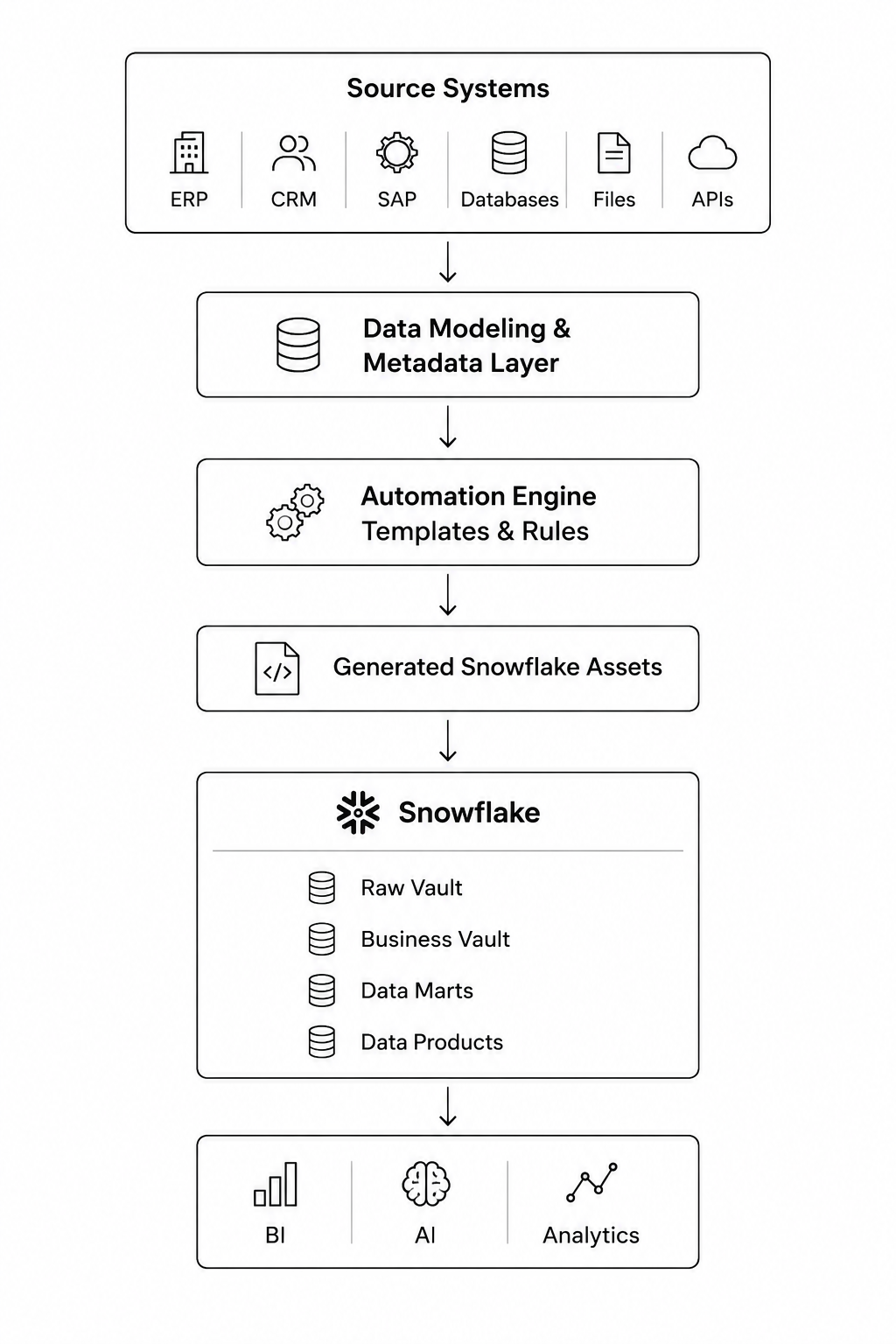
The Data Automation platform provides the data modeling, metadata, and automation capabilities that generate Snowflake-native assets from standardized templates and business rules. Snowflake remains the execution platform, supporting Raw Vault, Business Vault, Data Marts, and Data Products for analytics and AI workloads.
Accelerating Data Vault 2.0 on Snowflake.
Data Warehouse Automation is particularly valuable for organizations implementing Data Vault 2.0 on Snowflake.
Instead of manually creating and maintaining large numbers of Data Vault objects, teams define business entities and relationships that can be generated automatically, including: hubs, links and satellites.
Automation can also support:
Hash key generation
Loading patterns
Metadata synchronization
Dependency management
This reduces development effort while promoting consistency and adherence to Data Vault standards.
Automated Documentation and Lineage.
Documentation should be a byproduct of development, not a separate project.
Modern Data Automation platforms can automatically generate:
Data dictionaries
Technical documentation
Object dependencies
Transformation mappings
End-to-end lineage
This improves transparency, governance, and auditability while reducing manual documentation effort.
CI/CD and DataOps for Snowflake.
Snowflake teams require more than automated code generation.
Data Automation supports modern delivery practices including:
Iterative development
Rapid prototyping
Controlled deployments
Environment promotion
CI/CD integration
DataOps methodologies
This enables teams to scale Snowflake delivery while maintaining governance, quality, and consistency across environments.
Accelerating Snowflake Migration.
Organizations migrating legacy data warehouses to Snowflake often face significant redevelopment challenges.Data Warehouse Automation helps accelerate migration initiatives by supporting:
Metadata extraction
Schema conversion
Model generation
Automated deployment
Standardized development patterns
This approach can help organizations migrate data platforms to Snowflake faster, more consistently, and with lower risk.
Manual Snowflake Development vs Data Warehouse Automation.
| Capability | Manual Snowflake Development | Data Warehouse Automation |
|---|---|---|
| Data Modeling | Manual | Metadata-driven |
| SQL Development | Hand-coded | Generated |
| Data Vault | Manual | Automated |
| Documentation | Manual | Generated |
| Lineage | Limited | Built-in |
| Impact Analysis | Limited | Extensive |
| CI/CD Support | Custom | Integrated |
| Change Management | High effort | Metadata-driven |
The result: Snowflake provides the scalable cloud platform, while Data Warehouse Automation streamlines the design, development, documentation, and management of data pipelines and data warehouses - reducing manual effort while improving governance, consistency, and delivery speed.
WhereScape
Quest for Knowledge has been at the forefront of innovative data practices for more than two decades, working with thought leaders such as Ralph Kimball to bring proven methodologies to the Benelux and Sweden. Today, our partnership with WhereScape further strengthens our ability to deliver fast, reliable, and scalable data automation solutions.
For more than 25 years, WhereScape has been a pioneer in data automation, helping organizations accelerate the delivery of modern data platforms. Read on to understand how the WhereScape RED, WhereScape3D, and WhereScape Data Vault Express (DVE) products simplify the design, development, and governance of modern data platforms - and how these products work together to deliver faster, more reliable data solutions.
Related Content.

What is Data Warehouse Automation and What Does It Mean for Your Analytics Team?
In simple terms, data warehouse automation is the process of automating data warehouse design, development, deployment, and maintenance. This process replaces traditional manual methods with automated ones, speeding up the entire data warehousing process and eliminating manual coding.